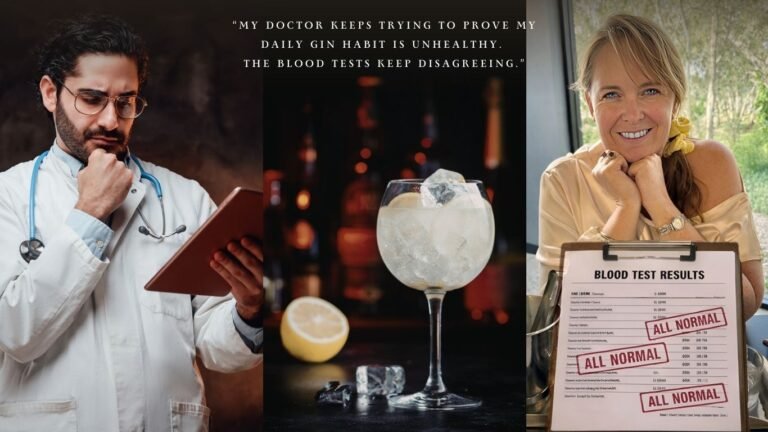
Every year—sometimes more frequently—he orders a fresh round of blood tests. Liver function, cholesterol, iron levels, metabolic markers, the full panel.
I suspect he hopes one day the results will confirm what many modern headlines insist must be true: that my daily ritual of one or two drinks will eventually reveal itself in the data.
So far, the numbers keep disappointing him.
Everything continues to come back stubbornly… normal.
At my most recent health check, the irony was particularly amusing: my biological age assessment came back at 51, despite my chronological age being 60.
Of course, anecdotes are not science. But they do make one curious about how we talk about alcohol in modern health discussions.
In recent years, public messaging around alcohol has become increasingly simplified.
Many studies that dominate headlines examine very high levels of consumption—patterns far removed from the moderate drinking habits seen across much of the world.
Yet those findings are often communicated in ways that suggest any amount of alcohol carries the same risk profile.
Science rarely works that way.
Human biology is influenced by a complex network of variables:
genetics
diet
physical activity
stress levels
sleep
social connection
overall lifestyle patterns
Reducing that complexity to a single variable rarely tells the whole story.
Before I became a distiller, I spent years working in skin science and cosmetic chemistry—a field deeply rooted in biochemistry and molecular interactions.
One thing science teaches you quickly is that dose matters.
Almost everything we consume—salt, sugar, caffeine, even water—can be harmful at extreme levels. Yet in moderate amounts, many of these substances are simply part of daily life.
Alcohol is no different.
Fermented beverages have been part of human culture for thousands of years, woven into food, celebration, and social rituals.
The question has never been whether alcohol exists in society.
The real question is how it is consumed.
As a distiller, I think about alcohol very differently from the way it often appears in policy debates.
For me, a spirit is not simply ethanol in a glass.
It represents:
agricultural ingredients
fermentation
distillation science
botanical chemistry
maturation
and craftsmanship
A well-made gin or whiskey is designed to be sipped slowly and appreciated, not consumed without thought.
This is why many in the craft spirits industry share a common philosophy:
Drink less. Drink better.
Moderation is one of the least glamorous words in modern culture.
It rarely makes headlines.
Yet historically, moderation has been central to how many cultures integrate alcohol into daily life—particularly when consumed with food, family, and community.
A small drink enjoyed slowly at the end of the day is a very different behaviour from excessive consumption.
Science, culture, and common sense all recognise this distinction.
My doctor still orders those tests.
And I will probably keep enjoying my evening gin.
Not as a health strategy.
Not as rebellion against medical advice.
Simply as a small daily ritual—a moment to pause, reflect, and appreciate the craftsmanship behind a well-made spirit.
For now, the blood tests remain stubbornly uneventful.
But my doctor hasn’t given up yet.
And honestly… neither have I.
“My doctor keeps trying to prove my daily gin habit is unhealthy. The blood tests keep disagreeing.”
As a former cosmetic chemist turned distiller, I find the conversation around alcohol and health far more nuanced than most headlines suggest.
A few reflections on moderation, science, and why craftsmanship changes how we think about spirits.